핵심이슈 동영상
#1
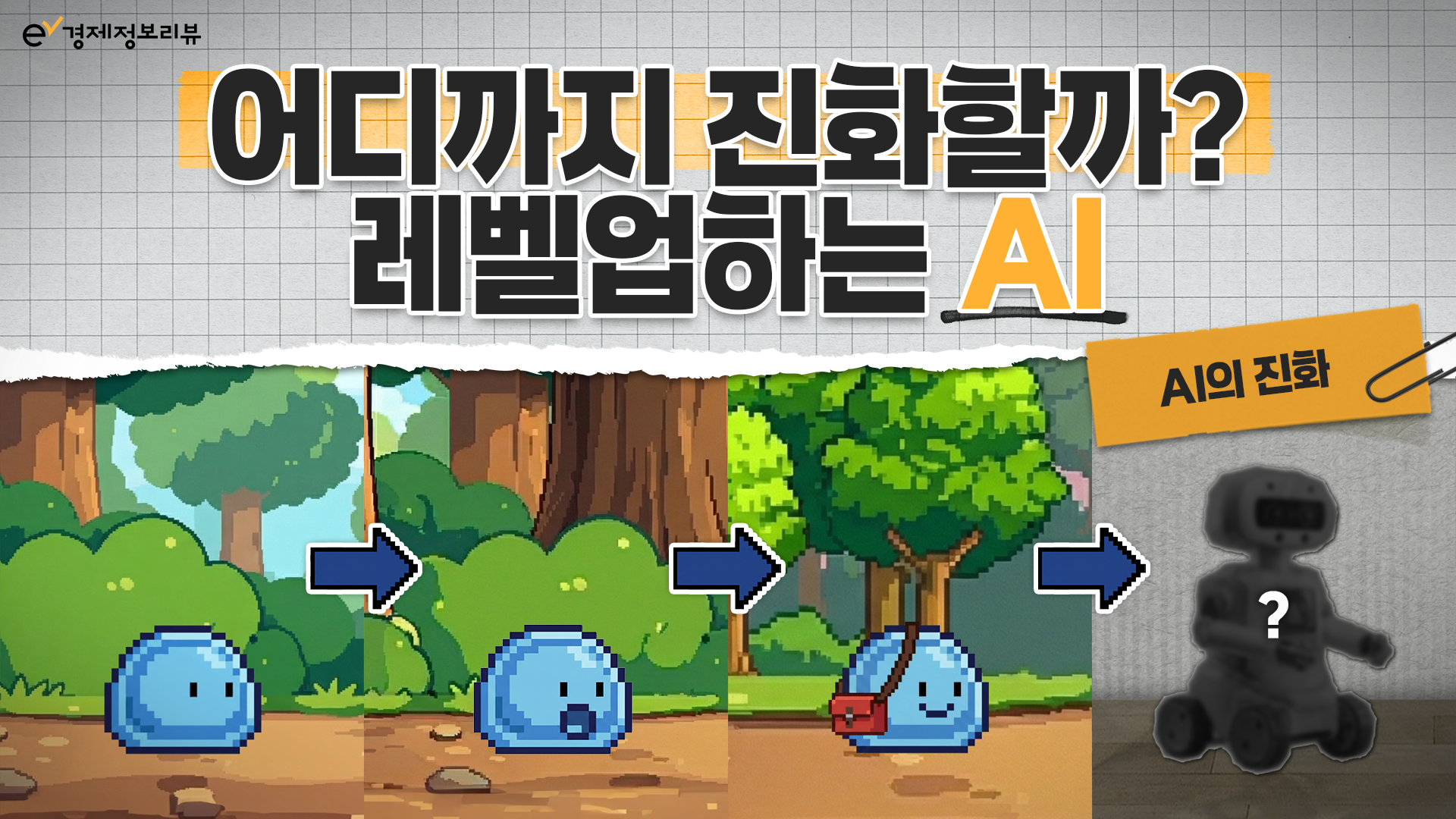
Everyone has a moment when they achieve something new for the first time.
AI is no different.
So let‘s play through AI‘s level-up journey together.
#2
In its early days, AI perceived the world based on rules explicitly written by humans.
But the world is full of countless variables.
It’s not easy to cover every possible case with rules alone.
#3
The “artificial neural network” overcame this limitation.
Like the human brain, with its countless interconnected neurons, it is a structure that allows AI to discover the laws of the world on its own.
When large amounts of data are fed into the input layer, the hidden layers detect patterns within the data.
Through “deep learning”―stacking multiple hidden layers―AI can identify patterns with even greater precision.
The output layer then produces the final prediction based on this information.
If the prediction misses the mark, the model works its way back to the input layer and recalibrates its decision-making criteria.
Through this process, it more accurately extracts the core patterns from the data.
By repeating this process of trial and error, AI has learned to recognize patterns across vast amounts of data, enabling it to make sense of the world.
#4
Now AI can understand the context of sentences and even generate them on its own.
Earlier AI processed words one by one, in order.
Because of this, it often lost the context as sentences grew longer.
#5
The “transformer” overcame this limitation by considering the entire sentence at once and identifying relationships among words.
Based on this, AI models that have been trained on massive amounts of text data are called “LLMs.”
LLMs use probabilities to predict the most natural and contextually appropriate words based on their training data.
This method of understanding context and generating optimal outputs has now expanded into a variety of areas, including images, music, and video.
#6
Now AI can find its own way toward a goal.
It can reason through what needs to be done to solve a problem and create step-by-step plans.
For tasks it cannot complete on its own, it can call on external tools to get the job done.
It then observes the results of its actions, evaluates whether those results align with the goal, and revises its plan as needed.
Drawing on memory of previous tasks, it can carry out tasks seamlessly.
#7
AI, once confined to the digital world,
now has a body and can act in the real world.
Physical AI perceives and analyzes real-world data through sensors and takes physical actions to achieve its goals.
Just like us, AI doesn’t start out perfect.
#8
AI goes through trial and error in simulated environments that replicate the real world.
Through these “world models,” it learns how to behave in the physical world.
Physical AI is moving into the real world, seeing, thinking, and acting just like humans.
#9
AI will continue to do things it has never done before.
As AI levels up, will our lives level up, too?


![[2025.07] 대출규제](/userdata/main/incContent/sideLink/23/aaaqQGcnBTcOc8zW9uLNz20251015165742zqfnw.png)
![[사람이 되고 싶어요2] 환율의 변화](/userdata/main/incContent/sideLink/22/aaaqQGcnBTcOc8zW9uLNz20251015165408vtzoa.jpg)